
Every figure is drawn from real, currently published official sources (ONS, HMRC, Insolvency Service, OBR) – nothing invented or projected. This version restructures the competitor's page order and adds four sections and three charts the competitor doesn't cover: SME/employment breakdown, the registered-vs-unregistered business gap, regional concentration, the VAT tax gap, and insolvency procedure types.
The Headline Numbers
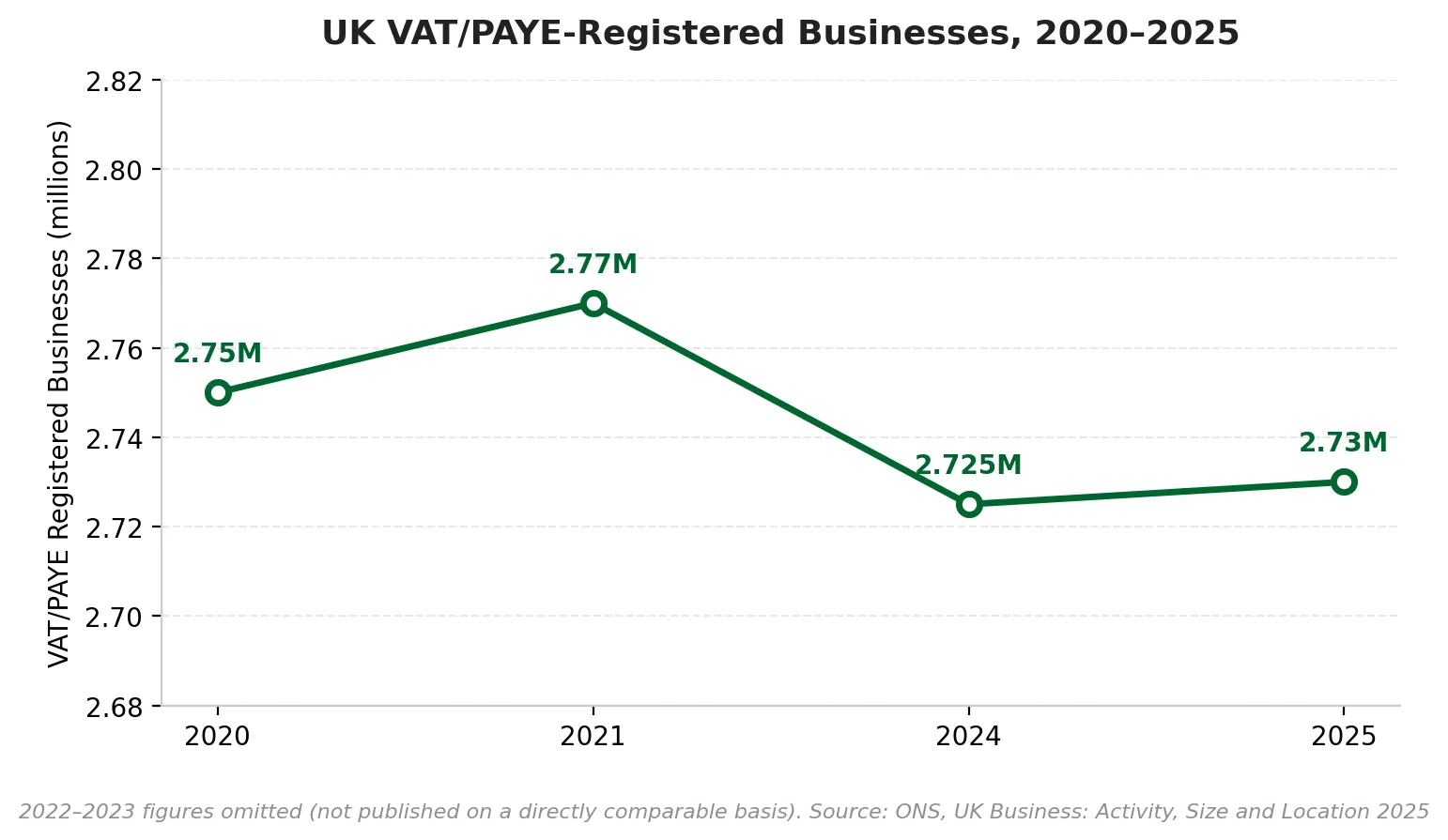
As of March 2025, there were 2.73 million VAT and/or PAYE-registered businesses in the UK – up 0.4% on March 2024's 2.725 million, and a genuine turning point after a small dip through 2023–24.
But that figure only tells part of the story. VAT/PAYE registration is just one measure of the UK business population, and it significantly understates how many businesses actually exist – which is where most VAT calculator sites stop, and where the real picture gets more useful.
Why “How Many UK Businesses” Has Two Very Different Answers
If you've seen both a “2.73 million” figure and a “5.7 million” figure for UK businesses and wondered which is right – they're both right, measuring different things.
2.73 million is the number of businesses registered for VAT and/or PAYE with HMRC – the businesses large enough, or structured in a way, to need to register.
5.7 million is the total UK private sector business population, including every unregistered sole trader and small partnership trading below the thresholds.
At the start of 2025, ONS estimated that 2.6 million businesses (46% of the total) were VAT and/or PAYE registered, while 3.0 million (54%) traded without being registered for either. That gap has been narrowing: only 44% of businesses were registered back in 2020, so the registered share has grown by two percentage points in five years – a sign that more sole traders and small partnerships are growing into registration territory, or choosing to register voluntarily.
Worth knowing: registration rates vary hugely by business structure. Only around 12% of sole proprietorships are VAT/PAYE registered, compared with 44% of ordinary partnerships – reflecting how much bigger the average partnership tends to be.
Small Businesses Still Run the UK Economy
Whichever of the two business counts you use, the UK economy is overwhelmingly small-business territory. Of the 5.7 million private sector businesses at the start of 2025, small and medium businesses (up to 249 staff) made up 99.9% of the total – 5.64 million with 0–49 staff, 38,435 medium-sized businesses, and just 8,335 large businesses with 250+ employees.
These businesses aren't marginal to the economy either: UK private sector businesses employed 28.1 million people at the start of 2025, and small and medium businesses provided 60% of those jobs (roughly 16.7 million people) and 51% of private sector turnover – a genuinely central role, not a footnote.
Is the Insolvency Picture Improving in 2026?
The conditions that drove business closures through 2022–24 – high inflation, rising interest rates, reduced consumer spending, elevated energy costs – have started to ease, and the 2026 insolvency data reflects that clearly rather than just asserting it.
Company insolvency rate: in the 12 months to May 2026, the UK company insolvency rate was 50.9 per 10,000 companies on the effective register (1 in 196) – down from 53.0 per 10,000 a year earlier, and well below the post-pandemic peak of 57.3 per 10,000 in late 2023.
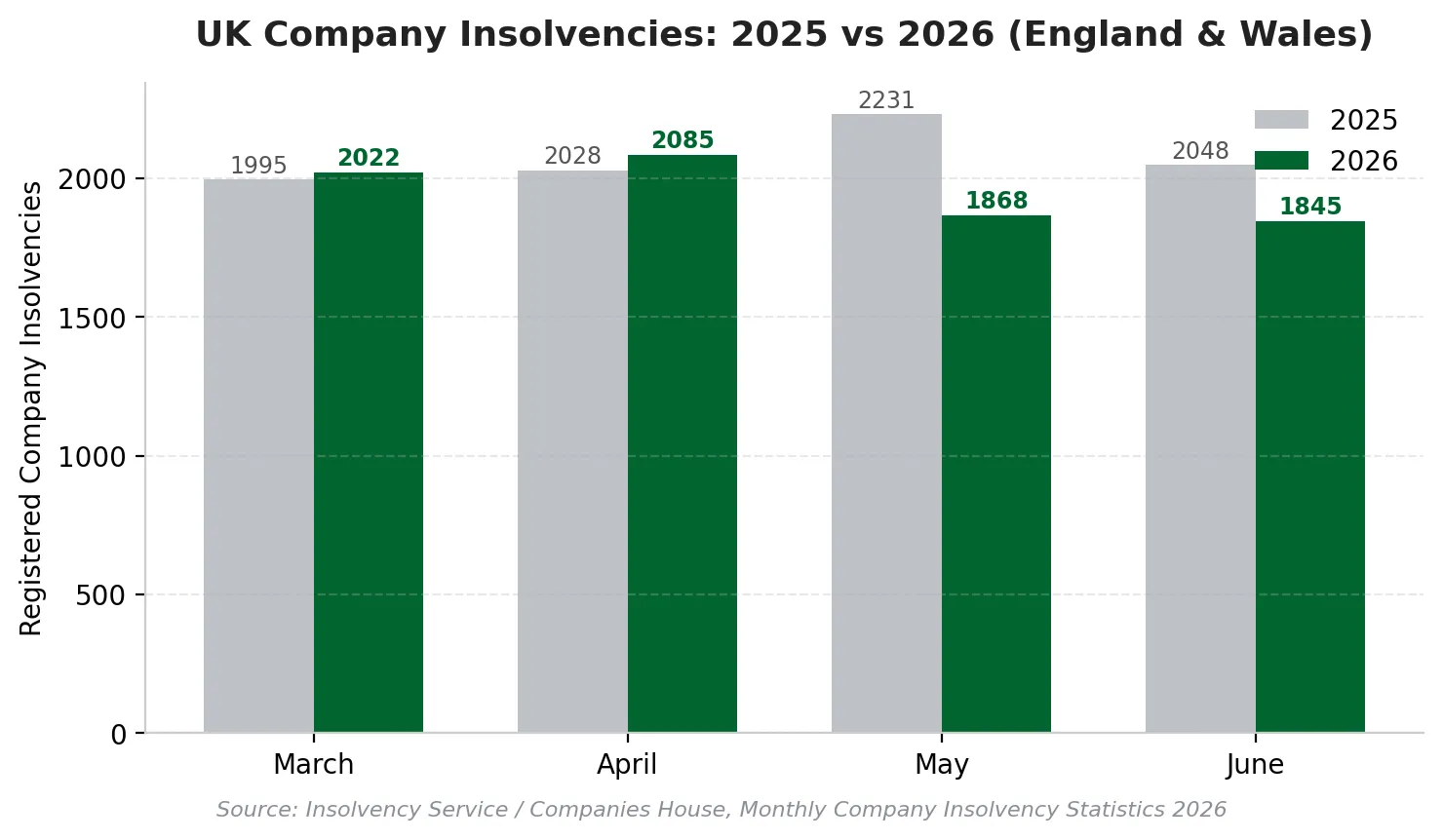
June 2026 saw 1,845 registered company insolvencies in England & Wales – 10% lower than June 2025's 2,048. This is a genuine, published trend reversal, not a projection.
What Type of Insolvency Is Most Common?
“Insolvency” isn't one single process – it covers four distinct legal procedures, and knowing the difference matters if you're assessing your own risk or a supplier's. In June 2026:
- Creditors' Voluntary Liquidations (CVLs) – director-initiated closures once a company can't pay its debts – made up 74% of all insolvencies (1,364 cases), by far the most common route.
- Compulsory liquidations – usually forced by a creditor petition, often HMRC – accounted for 15% (276 cases).
- Administrations – typically used to try to rescue a business or sell it as a going concern – made up 10% (191 cases).
- Company Voluntary Arrangements (CVAs) – a formal repayment plan that lets a company keep trading – were rare, at under 1% (14 cases).
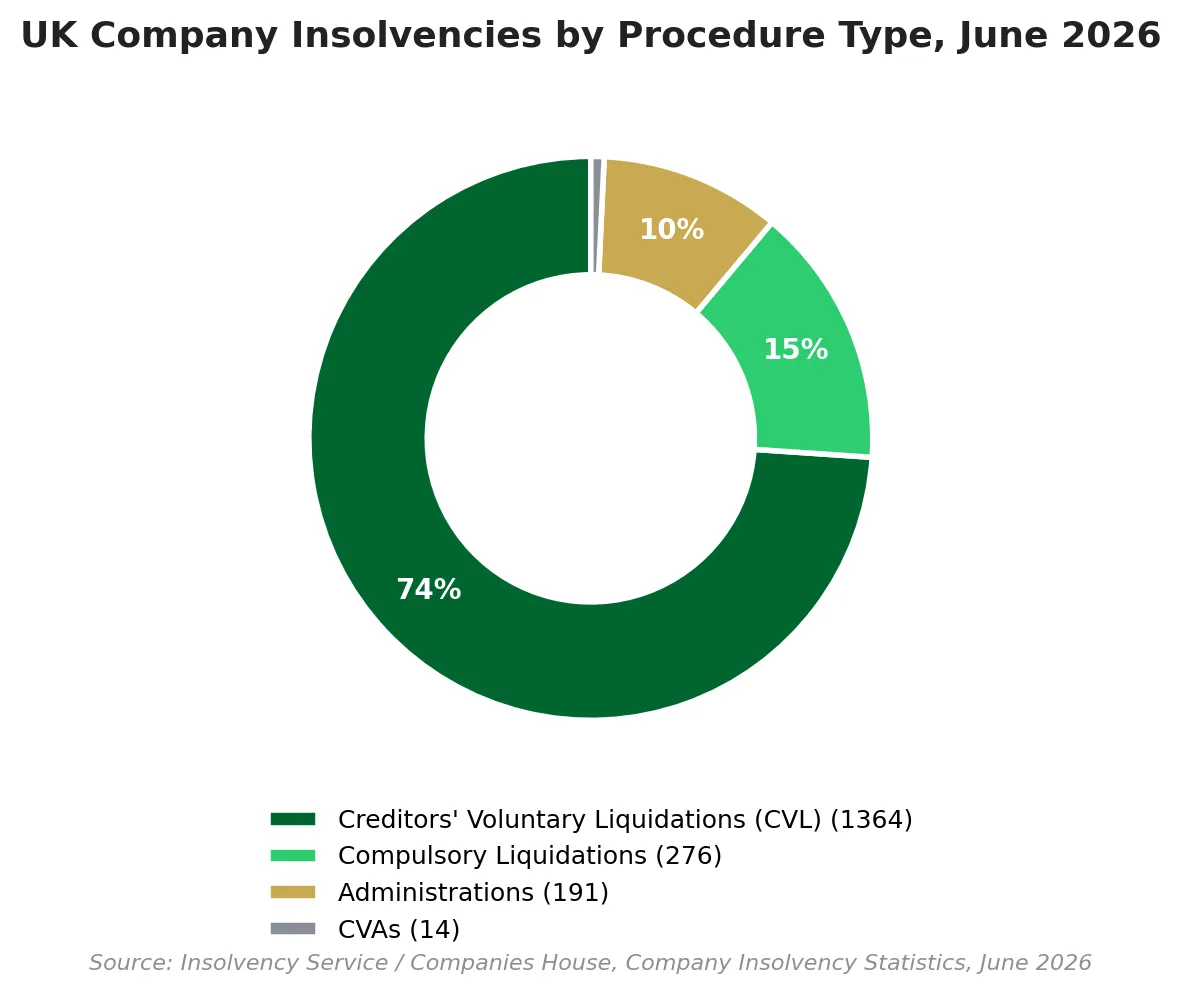
The dominance of director-led CVLs over creditor-forced compulsory liquidations suggests most struggling companies are choosing to wind down in a controlled way rather than being forced into it – generally a better outcome for creditors and directors alike.
What's Still Pushing Businesses to Stay Below the Threshold
- Threshold avoidance: some businesses deliberately keep turnover below £90,000, or split operations into multiple entities, to avoid VAT registration and the pricing/admin implications that come with it.
- Ongoing Brexit-related friction: smaller exporters and importers continue to face added paperwork and cost pressure versus pre-Brexit trading, pushing some to restructure or shift activity outside the UK.
- Growth of informal and gig work: a growing share of economic activity – freelancing, delivery platforms, and similar – happens without ever reaching the VAT threshold or opting into registration, keeping it outside official VAT statistics entirely.
If you're weighing up whether staying below the threshold makes sense for your business, use the VAT calculator above to see exactly how your prices and margins would look on either side of that line.
Where VAT-Registered Businesses Are Located
London and the South East between them account for more than a third of all VAT/PAYE-registered enterprises in the UK – a concentration that has barely shifted across a decade of these statistics.
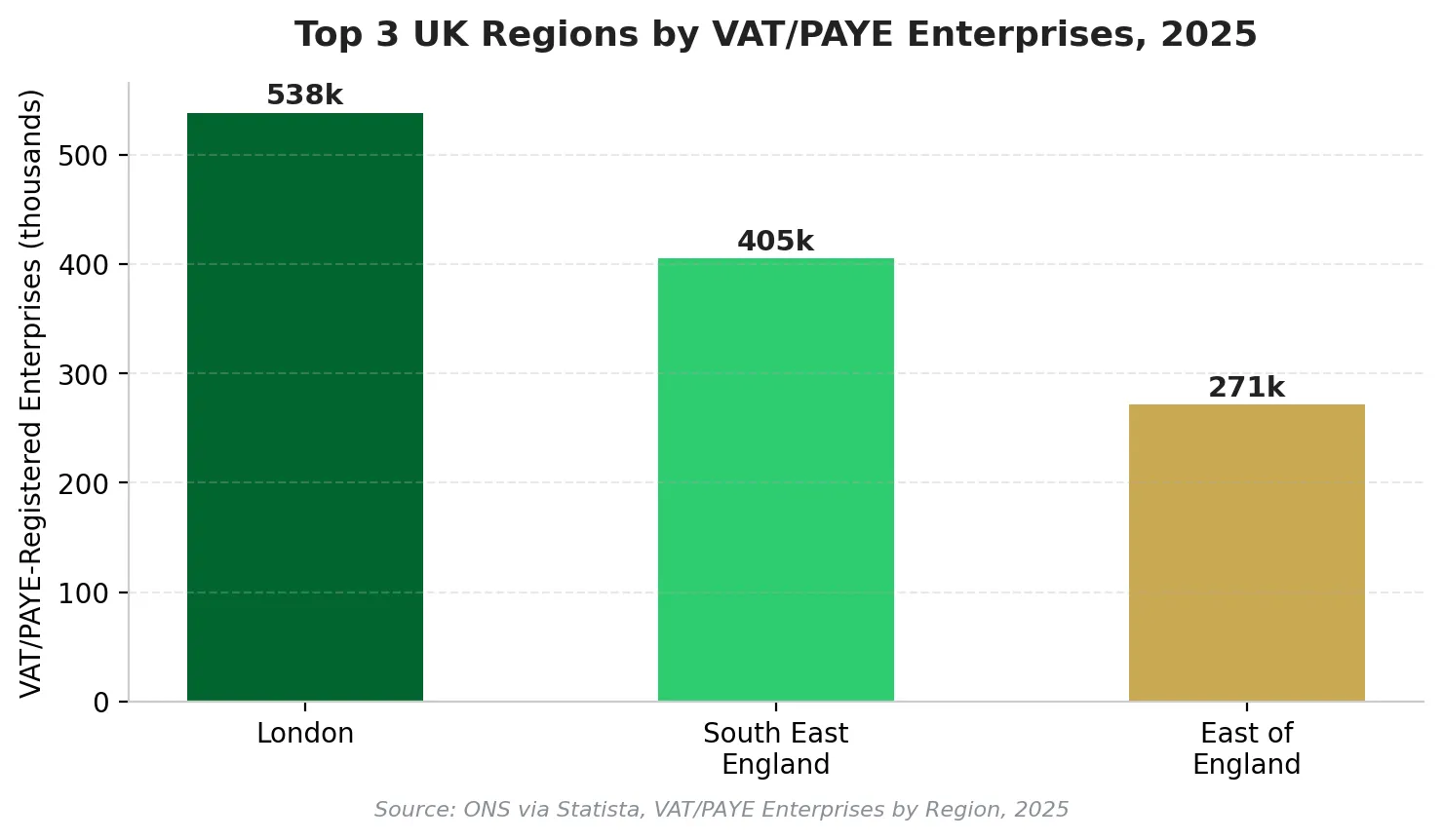
London alone had 538,315 VAT/PAYE-registered enterprises in 2025, with the South East close behind at 404,910 and East of England third at 271,475. That gap between the capital and the rest of the country has real implications for anything from B2B pricing strategy to where competitor density is highest.
VAT Registration by Company Type
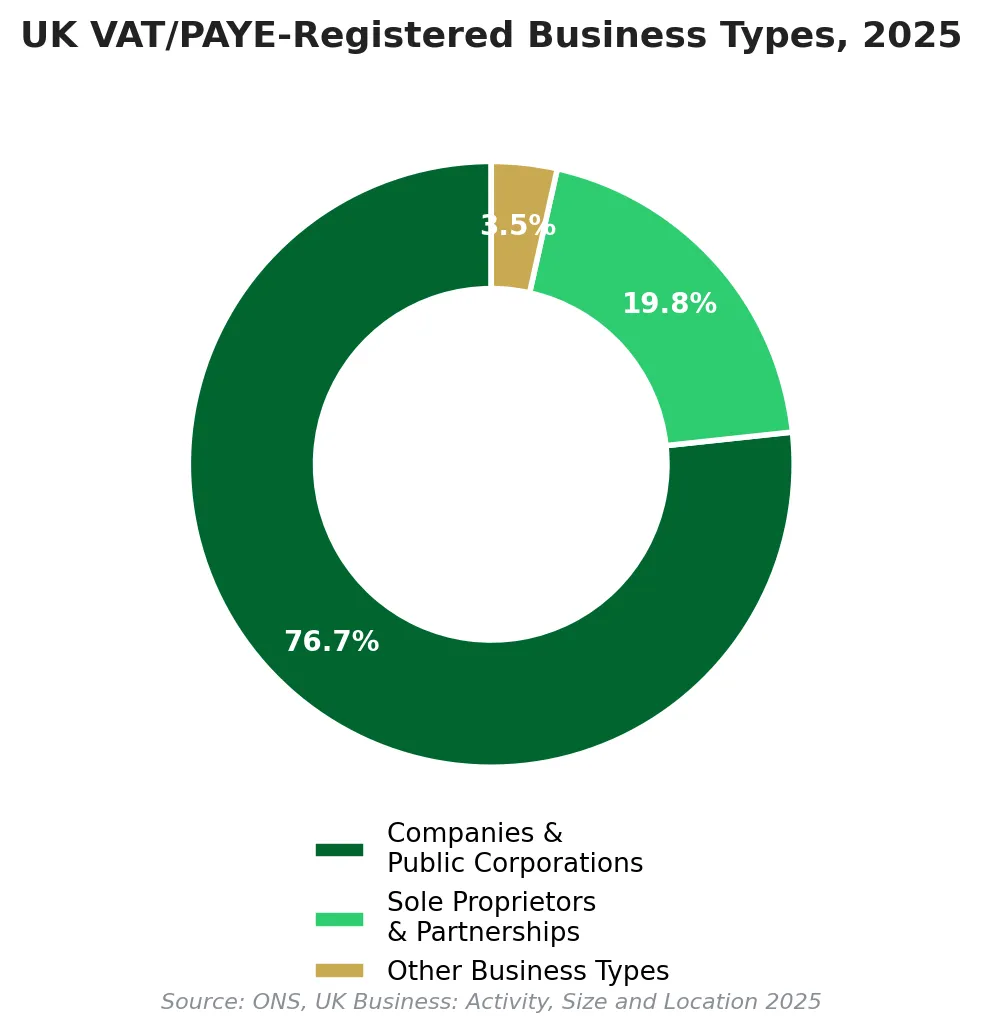
Limited companies continue to dominate the UK's VAT/PAYE-registered business population, and their share is growing: companies and public corporations made up 76.7% of all VAT/PAYE-registered businesses as of March 2025, while the combined share of sole proprietors and partnerships fell to 19.8%.
Which Industries Have the Most VAT-Registered Businesses?
Professional, Scientific & Technical remains the UK's largest industry group by a clear margin – 15.3% of all VAT/PAYE-registered businesses as of March 2025, roughly 419,570 enterprises. Construction follows with around 384,830, and Business Administration & Support Services with around 222,000.
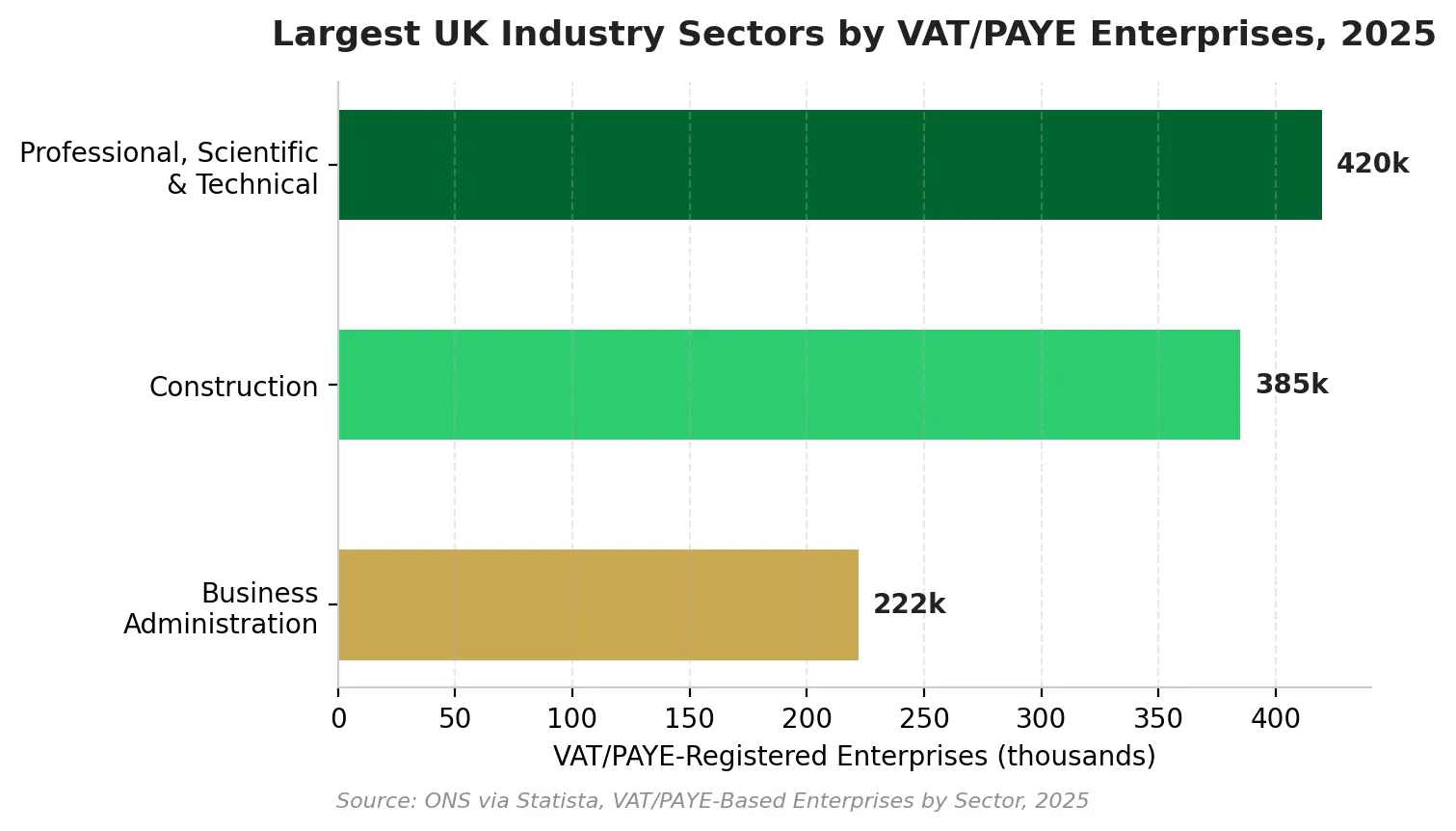
Construction is a sector to watch: while it's the second-largest sector by business count, Construction is also currently the largest sector by insolvency volume in the 12 months to May 2026, ahead of wholesale/retail and accommodation & food services – a sign of how exposed the sector is to project financing costs, payment delays, and material price swings, even while its overall business count keeps growing.
The VAT Tax Gap: How Much Goes Uncollected
The VAT gap is HMRC's estimate of the difference between the VAT it should collect in theory and what actually gets paid – covering everything from genuine errors to deliberate evasion. It's one of the clearest long-term measures of how well the VAT system is actually working.
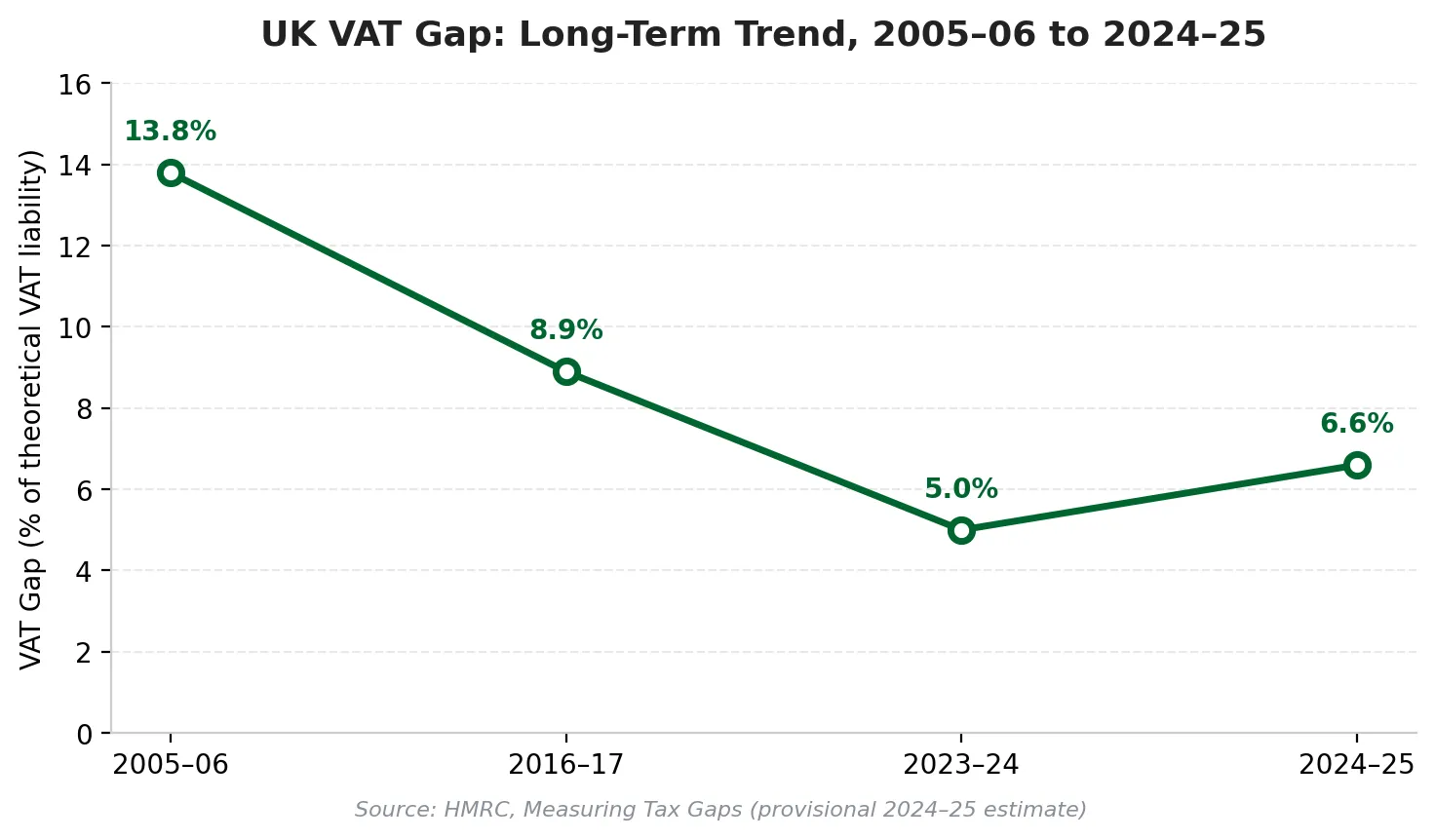
The trend over two decades is a genuine success story: the VAT gap has fallen from 13.8% of theoretical liability in 2005–06 to a low of around 5.0% in 2023–24. The provisional estimate for 2024–25 has ticked back up to roughly 6.6% (about £11.9 billion) – still far below historic levels, but a reminder that the gap isn't on an automatically downward path.
For context, small businesses account for a growing share of the wider UK tax gap across all taxes – which is part of why HMRC has been investing in Making Tax Digital and additional compliance staff in recent years.
How Much VAT Does the UK Actually Collect?
VAT receipts totalled approximately £180.7 billion in 2025–26 – around 19% of all HMRC tax receipts, and roughly 5.9% of UK national income. Total HMRC receipts across all taxes reached £938.8 billion in 2025–26, up 9.3% on the previous year, with Income Tax, Capital Gains Tax and National Insurance together making up 59% of that total and VAT the next largest single contributor.
Sources
Every figure on this page links directly to its original publication:
- ONS – UK Business: Activity, Size and Location 2025
- ONS – Business Population Estimates for the UK and Regions 2025
- ONS via Statista – VAT/PAYE-Based Enterprises by Region and by Sector, 2025
- HMRC – Annual UK VAT Statistics 2024 to 2025
- HMRC / OBR – HMRC Tax Receipts and NICs for the UK, Annual Bulletin 2025–26
- HMRC – Measuring Tax Gaps 2026 (provisional 2024–25 estimate)
- Insolvency Service / Companies House – Monthly Company Insolvency Statistics, March–June 2026
This page is for general information only and does not constitute financial or tax advice. Figures are updated as new official releases are published – always check the linked source for the most current data before relying on it for a business decision. ONS's next annual business count update (covering the March 2026 snapshot) is provisionally due 24 September 2026.